
Mental Health Treatment in Jaipur — Without Medicine, and Without Being Labelled
You do not need a diagnosis to come here. You do not need to know what is wrong, or have a name for it. "Something has not been right for a while" is a complete reason to book a consultation.
- No labels, no lifelong tablets
- Female psychologist available online
- Confidential — family is not told
- Psychiatrist referral when needed
- 4.6/5
- Google rating
- Since 2022
- 4+ years in Jaipur
- ₹500
- Registration books your slot
- Natural
- Healing without medicines
Our mental health treatment in Jaipur works through counselling, yoga therapy, meditation, breathwork and nutrition — no medicine at any stage. Where medication is genuinely needed, we tell you plainly and refer you to a psychiatrist.
Can mental health problems be treated without medicine?
Many can be substantially improved without it — particularly anxiety, stress-driven symptoms, sleep problems, overthinking and mild to moderate low mood. These respond to counselling, nervous system regulation, sleep correction and lifestyle change. Severe depression, psychosis, bipolar disorder and some other conditions need psychiatric care, and sometimes medication.
We assess which situation you are in and say so honestly, rather than taking on every case.
Before the practicalities — is this you?
- Braced for something bad to happen, without knowing what
- Lying awake at 2am with your mind going at full speed
- Tired in a way that sleep does not fix
If any of that is yours, you are reading the right page. The fuller list is in Mental health symptoms when your reports are normal below. What follows first is the plain practical answer: what we do about it, and what it costs.
What our mental health treatment in Jaipur involves
No medicines at any stage. A structured programme built from counselling, nervous-system work and lifestyle correction.
What we use: Counselling · CBT-based techniques · Nervous system regulation · Meditation and dhyan · Yoga therapy · Sleep correction · Nutrition · Routine — each one explained in detail in How we treat mental health without medicine below.
Session format: 45 minutes · Hindi or English · online or at our Mansarovar centre · female professional available
What it costs
| Step | Fee |
|---|---|
| Registration — books your time slot | ₹500 |
| First consultation deposit — at the centre | ₹1,000 |
| First consultation deposit — online | ₹500 |
| Sessions after that | around ₹2,000 each, personalised |
All payments are non-refundable. We sell no medicines, supplements or products, so there is nothing further to buy.
Why people choose Manorath for mental health treatment in Jaipur
- Nothing is sold to you. No medicines, no supplements, no products. There is no product revenue here, so no incentive to tell you that you need one.
- Mind and body treated as one case. Most places treat one or the other. Your anxiety and your acidity are usually the same case here, not two appointments.
- We refer you out when you need a doctor. If your case belongs with a physician or psychiatrist, we tell you in the first consultation instead of keeping it.
- Personalised, not a package. We cannot quote a session count before meeting you, and we will not pretend to.
- Hindi or English, whichever you are comfortable in. Switch mid-sentence — most people do.
- Online or at the centre in Narayan Vihar, Mansarovar.
Mental health symptoms when your reports are normal
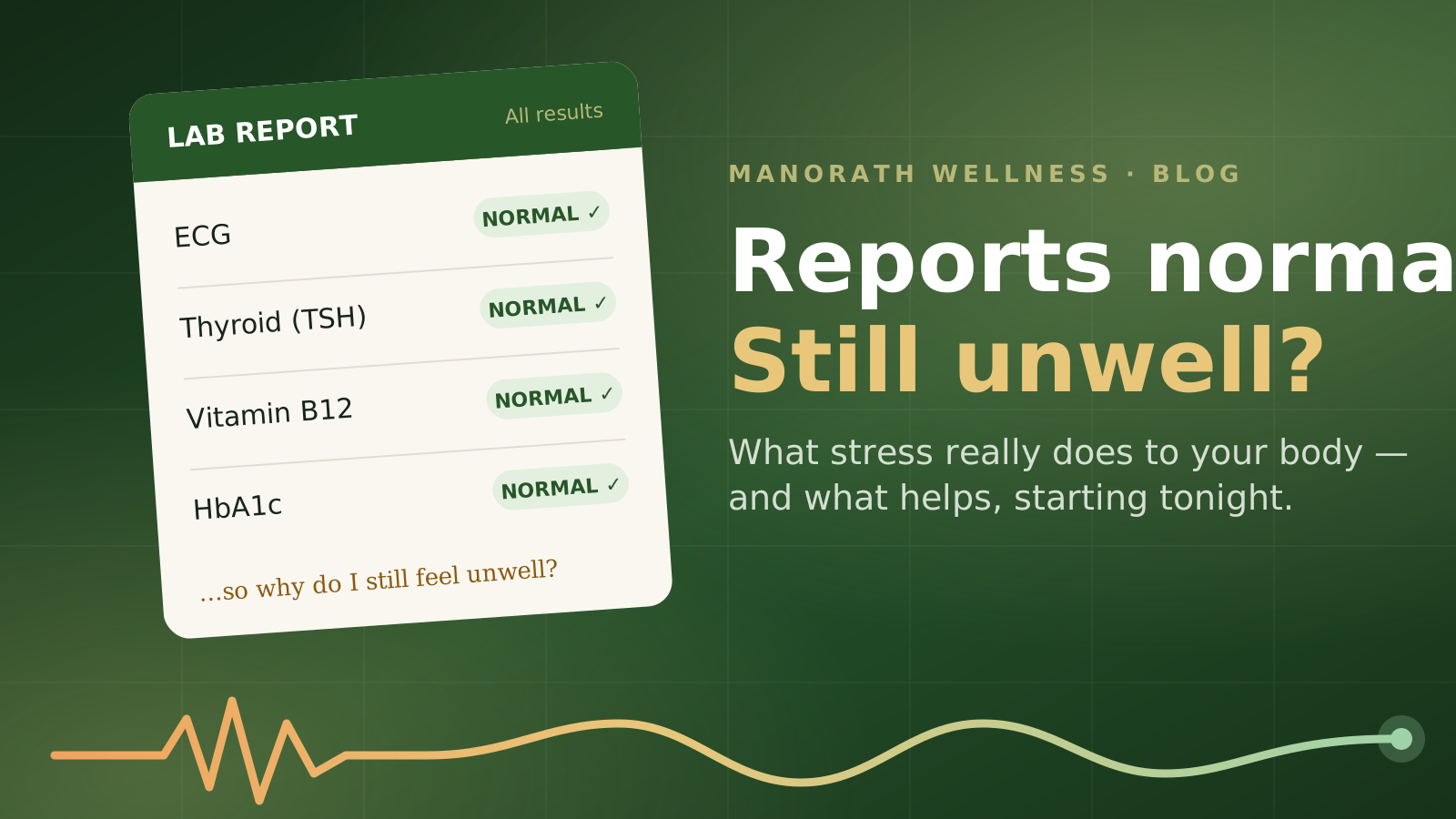
This is the most common thing we hear. You have been to a doctor. Your blood tests came back fine. Your ECG was fine. You were told it is stress, or that you are fine, or to relax.
And you are still:
- Braced for something bad to happen, without knowing what
- Lying awake at 2am with your mind going at full speed
- Tired in a way that sleep does not fix
- Snapping at people you love and hating yourself for it
- Unable to make yourself do things you used to do easily
- Feeling your heart race for no reason you can point to
- Crying at things that should not cause crying
- Checking, re-checking, or unable to stop a thought that you know makes no sense
- Avoiding people, calls, meetings, or leaving the house
Your reports can be normal and your symptoms can still be completely real. A blood test measures chemistry. It does not measure what your nervous system is doing. Those are different things, and the second one can make you genuinely unwell while the first one looks perfect.
That is not a dismissal of your doctor. It is just the limit of what those tests were designed to find.
Why mental health problems produce physical symptoms
This is the part that is usually skipped, and it is the part that makes everything else make sense.
Your nervous system has two main modes. The sympathetic mode is fight or flight — it exists to get you out of danger. The parasympathetic mode is rest, digest and repair.
In sympathetic mode, your body does specific things. Heart rate rises. Breathing becomes shallow and fast. Blood is sent to large muscles and away from the digestive system. Muscles tense, particularly neck, jaw and shoulders. Digestion slows or becomes erratic. Sleep becomes light and broken.
Every one of those is a symptom people come to us with. Palpitations. Breathlessness. Acidity and bloating. Neck pain and headache. Insomnia.
The problem is that this system was built for short bursts — a threat, a response, then recovery. It was not built to stay switched on for months because of a job, a marriage, a loan, an exam, or a loss. When it does stay on, the symptoms stop being occasional and start being your normal state.
The parts involved. Your amygdala detects threat and triggers the response. It is fast and it is not precise — it cannot reliably tell the difference between physical danger and a difficult conversation. Your prefrontal cortex is the part that assesses whether the threat is real and calms the system down, but under sustained stress its regulating influence weakens. Cortisol, the main stress hormone, stays elevated instead of returning to baseline, and chronic elevation affects sleep, appetite, immunity, blood sugar and mood.
The gut is part of this. The vagus nerve connects brain and gut directly, and signals travel in both directions. This is the gut-brain axis. It is why anxiety produces stomach symptoms, and also why an inflamed, poorly functioning gut can worsen mood. Most of the body's serotonin is in fact produced in the gut — though it works locally there, on motility and secretion, rather than crossing into the brain, so it is the nerve and immune signalling along this axis that links the two, not gut serotonin travelling upwards. Either way, digestion is not a separate department from mental health. We work on this directly.
The subconscious layer. Many of the patterns driving this — the automatic catastrophic prediction, the self-criticism, the reaction that fires before you have decided anything — are not conscious choices. They are learned responses running below the level of deliberate thought. That is precisely why "just think positive" does not work. You cannot instruct a subconscious pattern out of existence. You have to work with it deliberately, which is what counselling does.
What responds well without medicine — and what does not
| Usually responds well to counselling and lifestyle work | Usually needs a psychiatrist, sometimes medication |
|---|---|
| Anxiety, overthinking, constant tension | Severe depression with inability to function |
| Stress-driven physical symptoms | Psychosis, hearing voices, losing touch with reality |
| Insomnia and disturbed sleep | Bipolar disorder |
| Mild to moderate low mood | Any thoughts of self-harm or suicide |
| Panic attacks | Severe OCD that fills most of the day |
| Exam, social and performance anxiety | Conditions already stabilised on medication |
| Anger and emotional reactivity | Withdrawal from alcohol or substances |
If you are in the right-hand column, we will say so in the first consultation and refer you. Many people work with both a psychiatrist and us at the same time, and that combination often works better than either alone.
Rated 4.6 / 5 on Google · 20 real reviews
What people in Jaipur say
In their own words — hover or tap a review to pause it.
Priyank Ji is my mental heath counsellor , he is very humble and listen you very gently. Lots of my emotional trauma and stress released by her with help of yoga and other therapies. I feel safe and non judgemental while talk to him.
Best place for peace! I was very stressed in life. Nothing made me happy. Then I came to Manorath Wellness Center. The team helped me so much. They talked to me nicely and gave me good support. Now I feel calm and happy from inside. This place is full of good people. 😊
They saved me! I was feeling very low. I had no energy to do anything. But after getting help …
I had been struggling with sleep for quite some time. What I liked here was that they first tried to understand my daily routine instead of simply suggesting something. The changes were simple and practical, and my sleep routine has become much better.
The whole team is really supportive, especially Priyank Sir. In the beginning, I was unsure whether these small steps would actually help me, but with time I started noticing a real difference. The overall environment feels very positive and peaceful. Their therapies and guidance have helped me a lot with my pain and well-being.
Mujhe anxiety ke time par bahut restless feel hota tha, especially when I had too many things going on at once. Sessions mein breathing aur other practices ko daily routine ka part banana sikhaya. Ab stressful situations mein pehle se kaafi calmly respond karti hoon.
Can’t explain in words how much selfless efforts they do for people with genuine care. Everyone should visit this place at least once to experience a deep connection with their inner self and the Divine, and to gain a new perspective on life.
I joined the yoga classes mainly because of back and joint stiffness, but I ended up enjoying the whole routine. The teacher was patient and explained which movements I should do comfortably. I don't feel like I am forcing my body anymore.
Manorath Wellness Center changed my life! I took online yoga classes from here. The trainer was very kind and helpful. They not only taught yoga but also helped me understand life better. Now I feel stress-free and happy. My mind is calm and clear. I feel more energy every day. If you want peace and clear thinking, this place is perfect.
PCOD ke saath weight aur periods dono ko lekar kaafi frustration thi. Yahan mujhe diet, yoga aur daily routine ko ek saath manage karne ka practical approach mila. Sab kuch ekdum overnight change nahi hua, but I feel I am finally working on the right things.
I had never tried meditation properly before. Initially it was difficult to sit quietly even for a few minutes, but the guided sessions made it much easier. I now use some of the breathing and meditation techniques even on busy workdays.
Meri mother ko knee pain ki wajah se daily activities mein discomfort hota tha. Consultation ke baad unhe exercises aur routine ke baare mein properly guide kiya gaya. The best part was that nobody rushed her or made her feel uncomfortable during the sessions.
I got my 66-year-old father to join the online sessions. He started with simple chair-based practices. After two months, his morning stiffness has reduced and he has become more active at home.
I went mainly for diet and weight management advice. Instead of giving me a very strict diet chart, they asked about what I actually eat and what I can realistically follow. That made a big difference because I have been able to stay consistent.
I was really worried about my overthinking and stress, so I started classes with Manorath Wellness. There, I joined yoga classes along with wellness counseling. Honestly, it helped me a lot, and now I'm able to handle my stress better. ❤️
I was quite hesitant about counselling because I had never spoken openly about some personal issues. The sessions felt private and comfortable, and I never felt pushed to say something before I was ready. That made it much easier for me to continue.
I am feeling very good after joining yoga.
Ayurvedic treatment was a new experience for me, so I had quite a few questions in the beginning. The doctor explained everything patiently and also discussed my routine and food habits. I liked that the approach was personalised rather than just giving general advice.
The naturopathy sessions were quite different from what I expected. I was given guidance around food, daily habits and natural therapies, and the team kept checking how I was feeling. Overall, it was a very calm and positive experience.
Work stress had started affecting my mood, sleep and even my weekends. I joined the wellness program to bring some structure back into my routine. The combination of yoga, breathing and lifestyle guidance has helped me become more mindful about how I spend my day.
The part other centres leave out
What mental health treatment in Jaipur can and cannot do
What typically improves first: sleep and the physical symptoms — palpitations, tension, the stomach. Then the intensity of the anxiety or low mood. Then your tolerance for the things that currently set it off.
What this asks of you: the practice between sessions. The breathwork, the sleep timing, the walk. The session is where we work out what to do; the change happens in the six days in between.
Timeline, honestly: some people notice the physical symptoms settling within two or three weeks. Patterns that are years old take longer. Anyone who promises you a fixed timeline without meeting you is selling something.
What we do not do: we do not diagnose, we do not prescribe, and we do not treat psychiatric emergencies. We will not tell you to stop medication a psychiatrist has prescribed — never do that on your own. If your situation needs psychiatric care, we say so in the first consultation and point you to it.
The lifestyle changes that improve mental health most
People expect this part to be the filler. It is not. For a large number of the people we see, this is where the change comes from.
Sleep. This is the single biggest one. Sleep deprivation raises next-day anxiety measurably and lowers emotional regulation. A disturbed circadian rhythm disturbs mood, appetite and cortisol together. Fixing sleep timing often improves mood before any other intervention takes hold. Sleep problems frequently need to be addressed first.
Morning light. Light in the first hour after waking anchors your circadian rhythm and sets the timing of melatonin release that night. In practical terms: fifteen minutes of daylight in the morning improves sleep that night.
Movement. Not gym culture, just regular movement. It reduces circulating stress hormones and supports the brain's capacity to form new patterns. A daily walk, done consistently, outperforms an ambitious plan abandoned in a week.
Dopamine and serotonin, honestly. These are often discussed as though they are things you can top up. They are not. But they are supported by things that are genuinely under your control — consistent sleep, daylight, movement, adequate protein, and completing small tasks. What reliably disrupts the systems they work in is erratic sleep, hours of passive scrolling, and alcohol.
Nutrient status. Low vitamin D and low vitamin B12 both produce fatigue, low mood and poor concentration, and both are extremely common in India — including among people who get plenty of sun, because of time spent indoors and sun avoidance. Low iron and ferritin cause exhaustion that is regularly mistaken for depression. Thyroid dysfunction mimics both anxiety and depression closely. These are worth testing before concluding anything about mood, and we will often ask you to.
Caffeine and alcohol. Caffeine has a half-life of around five to six hours, so an evening tea genuinely affects sleep quality. Alcohol makes you fall asleep faster and then fragments the second half of the night, which is why anxiety is frequently worse the day after drinking.
Mental health conditions we work with in Jaipur
Each of these has its own page with the full detail.
Mind and emotions
- Anxiety — constant tension, overthinking, palpitations, the sense that something bad is coming
- Depression and low mood — no motivation, no interest, exhaustion that is mistaken for laziness
- Panic attacks — sudden episodes that feel like dying, usually after a hospital visit where everything was normal
- OCD — repeated checking or washing, intrusive thoughts you know are irrational and cannot stop
- Phobia and specific fears — heights, lifts, travel, injections, driving
- Social anxiety and stage fear — not shyness, and it is costing you professionally
- Exam and performance anxiety — knowing the answers until you are in the hall
- Sleep problems and insomnia — waking at 3am, or never properly falling asleep
- Emotional patterns and anger — reactions you regret, mood shifts you cannot predict
Counselling and relationships
- Psychologist and counsellor consultation — if you would rather just talk to someone first
- CBT therapy — structured work on thought and behaviour patterns
- Child and teenage counselling — behaviour, anger, studies, screens, school refusal
- Marriage and relationship counselling — you can come alone
- Addiction support — judgment-free, no forced admission
- Sexual health counselling — private, and a female professional is available
How we treat mental health without medicine
Counselling. Talking to a professional who is trained to find the pattern, not just listen sympathetically. Hindi or English. Confidential.
CBT-based techniques. Structured work on the thought-emotion-behaviour cycle. Thought records, behavioural activation, graded exposure where relevant. How CBT actually works.
Nervous system regulation. Breathwork that moves you from sympathetic towards parasympathetic — diaphragmatic breathing, extended exhale, anulom vilom, bhramari. These are not calming rituals; they change your physiology, and they work because the breath is one of the few direct manual controls you have over the autonomic nervous system.
Meditation and dhyan. Built up gradually, starting shorter than you expect. Meditation sessions.
Yoga therapy. Sequenced for your state — activating where there is depression and flatness, calming where there is anxiety and agitation. Yoga classes.
Sleep correction. Often the first thing we address, because almost nothing else improves reliably while sleep is broken.
Nutrition. Protein adequacy, meal timing, caffeine, and nutrient gaps that affect mood. Clinical nutrition.
Routine. Structure is not a lifestyle aesthetic — an erratic daily rhythm keeps cortisol and sleep dysregulated. Magic Mornings exists for exactly this.
Your mental health consultation in Jaipur — what happens
Registration — ₹500. Books a confirmed time slot.
First consultation. 45 minutes. ₹1,000 deposit in person, ₹500 online. You talk first, for as long as you need. Then a structured assessment. Then an honest explanation of what we think is happening, whether we are the right people for it, and what the work would involve.
Sessions. Typically around ₹2,000, personalised. How many depends on your case — we will give you a realistic estimate after the first consultation, not before.
Language. Hindi or English, and you can move between them.
Format. At the centre in Mansarovar, or online.
Registration and deposit are non-refundable.
Your counsellor and psychologist — female professional available
A female psychologist and counsellor is available for online consultation. Mention it when you book and your sessions are arranged with her.
Priyank Dadhich, founder — PGDYT (Post Graduate Diploma in Yoga Therapy), trained in naturopathy, clinical nutritionist. He has led the work at Manorath Wellness since the centre opened in 2022 — more than 4 years of solution-oriented practice in Jaipur.
Say when you book if you would prefer a female or male professional.
Mental health treatment in Jaipur — your questions answered
Mann ki pareshani ka ilaj bina dawai ho sakta hai? Dimag shant kaise kare?
Bahut cases mein haan. Mental problem ka ilaj bina dawai — anxiety, neend, overthinking, mood — counselling, saans ki practice, neend sudharna aur khaanpaan se kaafi hota hai. Tanav door karne ka upay ek nahi hota: pehle dekhte hain aapke case mein kya chal raha hai. Lekin saaf baat — gambhir depression, bipolar ya psychosis mein doctor ki dawai zaroori hai, aur us haalat mein hum seedha refer karte hain, roke nahi rakhte.
Will mental health treatment put a label on me?
No. We do not diagnose. There is no label applied to you here, and nothing goes on any record that follows you. Most of the people we see have no diagnosis and do not need one to start working on this.
Will I be put on medicine for my mental health?
Not by us — we cannot prescribe and we do not. If your situation genuinely needs medication, we tell you that honestly and refer you to a psychiatrist. That is a decision for a doctor, not for us.
I am already on psychiatric medication. Can I still take mental health counselling?
Yes, and many people do. This works alongside psychiatric treatment. Never reduce or stop prescribed medication on your own — that decision belongs to the doctor who prescribed it. Tell us what you are taking so we can work around it sensibly.
Is mental health counselling in Jaipur confidential from family?
Yes. Nothing is shared with family, employers or anyone else without your consent. If you are an adult, the consultation is yours alone.
Is my problem serious enough for mental health treatment?
If it is affecting your sleep, your work, your relationships or your enjoyment of ordinary things, it is serious enough. Nobody here will tell you that your problem is too small.
What is the difference between a psychiatrist and a mental health wellness centre?
A psychiatrist is a medical doctor who can diagnose and prescribe. We are a wellness centre — counselling, nervous system work, lifestyle and nutrition, no medicines. For many conditions these are complementary rather than competing, and some people see both.
What if my mental health problem needs a psychiatrist?
Then you need to know that, and we will tell you. Part of the first consultation is working out whether this is something we can help with or whether you need a psychiatrist or physician. Sending you to the right place is more useful to you than keeping your case.
How long does mental health treatment take to work?
Physical symptoms and sleep often shift within a few weeks. The deeper patterns take longer. We will give you a realistic picture after assessing you, and it will be a range, not a promise.
Is online mental health counselling available in Hindi?
Yes. Counselling works well online and many people prefer it for privacy. Available in Hindi and English.
What should I bring to my first mental health consultation?
Recent reports if you have any — particularly thyroid, vitamin D, vitamin B12 and haemoglobin, since all four affect mood. A list of medicines you take. If you have nothing, come anyway.
What if I cannot explain what is wrong with my mental health?
Most people cannot, at first. "I don't know, something is just off" is where many consultations start. Finding the words is part of the work, not a prerequisite for it.
Where can I get urgent mental health help in India right now?
If you are having thoughts of harming yourself, please contact Tele-MANAS on 14416 — it is free, available 24 hours, and in multiple languages. If you are in immediate danger, go to the nearest hospital emergency department. We are a wellness centre and we are not equipped for emergencies, and we would rather tell you that plainly than have you wait for an appointment.
Visit our mental health and wellness centre in Jaipur
- Address
- Narayan Vihar, Mansarovar, Jaipur, Rajasthan
Open in Google Maps - Phone
- +91 78915 90022
- Message us on WhatsApp
- Hours
- Mon–Sat 9am–7pm at the centre
Online consultation all days - Parking
- Parking available at the centre
Manorath Wellness
Narayan Vihar, Mansarovar, Jaipur, Rajasthan
Easily reached from Mansarovar, Nirman Nagar, Sodala, Vaishali Nagar and Ajmer Road. Online consultation available anywhere in India. Parking available.
What people tell us they want
“Understanding that what I have is explainable, common, and not the end of my normal life.”
How it starts
Three simple steps
- 1 Tell us what is going onA short form, a WhatsApp or a call — in Hindi or English.
- 2 A 45-minute consultationMind and body looked at together, at the centre or online.
- 3 A plan around your real dayFood, movement, sleep, breath and stress — and follow-ups that adjust.
Who you would be dealing with
- Led by
- Priyank Dadhich — PGDYT, clinical nutritionist
- Experience
- 4+ years · centre open since 2022
- Google rating
- 4.6 out of 5
- Our approach
- Healing without medicines — we treat the root cause
Rated 4.6/5 · since 2022 · medicine-free healing
Ready to start?
You do not need a diagnosis, a crisis, or the right words to book. "Something has not been right for a while" is enough.
₹500 registration gets you a confirmed slot. Sessions run in Hindi or English, online or at our Mansarovar centre, and a female professional is available if you would prefer that.
If you are in crisis right now, call Tele-MANAS on 14416 — free, 24 hours — rather than waiting for an appointment.
Or call +91 78915 90022 · Mon–Sat 9am–7pm · Online all days