
Panic Attack Treatment in Jaipur — You Are Not Dying, and Here Is Why
If this is happening right now, go to the next section. Read nothing else first.
If it has passed and you are trying to understand what happened to you — this page explains it, and explains what panic attack treatment in Jaipur actually involves.
- What to do during an attack
- Heart always checked first
- No lifelong tablets
- Hindi or English · centre or online
- 4.6/5
- Google rating
- Since 2022
- 4+ years in Jaipur
- ₹500
- Registration books your slot
- Natural
- Healing without medicines
If it is happening right now
Read slowly. One line at a time.
You are not having a heart attack. You are not dying. Fainting is very unlikely — in a panic attack your blood pressure rises rather than drops, which is the opposite of what makes people faint.
This will peak and pass. It peaks within about ten minutes and usually settles within twenty to thirty, though attacks can come in waves. It cannot continue indefinitely — your body physically cannot sustain the adrenaline.
Do this. Breathe out longer than you breathe in.
In through the nose, 4 counts. Out through the mouth, 8 counts. Again. Keep going.
The long exhale is the part that works. It activates the vagus nerve and begins slowing your heart.
Then name five things you can see. Out loud if you can. Then four things you can touch. Then three sounds.
Do not fight it. Fighting it adds fear, and fear adds adrenaline. Let it move through. It is unpleasant and it is not dangerous.
Sit down. Do not lie flat — upright helps your breathing. Loosen anything tight at your neck.
It is passing already. It always does.
What is a panic attack?
A panic attack is a sudden surge of adrenaline — the full fight-or-flight response firing without an external threat. It produces racing heart, chest tightness, breathlessness, dizziness, trembling, sweating, numbness or tingling, and a powerful sense of impending death or loss of control.
It peaks within about ten minutes and passes. It is extremely frightening, it is physically harmless, and it is one of the most treatable conditions in mental health — most people improve substantially without medication.
Before the practicalities — is this you?
- Blood vessels narrowing, including to the brain → dizziness, light-headedness, blurred vision, a sense of unreality
- Nerves becoming more excitable → tingling in the hands, feet and around the mouth
- Chest wall muscles tightening → the chest pain, which is muscular, not cardiac
If any of that is yours, you are reading the right page. The fuller list is in What happened to you — in order below. What follows first is the plain practical answer: what we do about it, and what it costs.
What our panic attack treatment in Jaipur involves
You leave the first session able to shorten an attack. That is the first priority.
What we use: Breath retraining — the first and most important thing · Understanding the mechanism · CBT · Dropping safety behaviours · Graded return to avoided places · Sleep correction · Yoga therapy — each one explained in detail in How we treat panic attacks in Jaipur below.
Session format: 45 minutes · Hindi or English · online or at our Mansarovar centre · a female professional is available
What it costs
| Step | Fee |
|---|---|
| Registration — books your time slot | ₹500 |
| First consultation deposit — at the centre | ₹1,000 |
| First consultation deposit — online | ₹500 |
| Sessions after that | around ₹2,000 each, personalised |
All payments are non-refundable. We sell no medicines, supplements or products, so there is nothing further to buy.
Why people choose Manorath for panic attack treatment in Jaipur
- We explain exactly what happened to you. You were probably sent home from hospital with "it was just anxiety" and no explanation. That is almost worse than no answer at all.
- Panic disorder has one of the best outlooks in mental health. Most people improve substantially without medication, and we will tell you that at the start.
- You get the tools in the first session — breathing and grounding, practised in the room rather than described.
- We tell you to see a doctor for chest pain, always. We are not equipped to assess cardiac risk, and a wasted trip to an emergency department costs you an evening.
- We work on the avoidance, not just the attacks. The shrinking list of safe places is what actually costs you your life, and it responds best to treatment.
- Hindi or English, online or at the centre.
What happened to you — in order
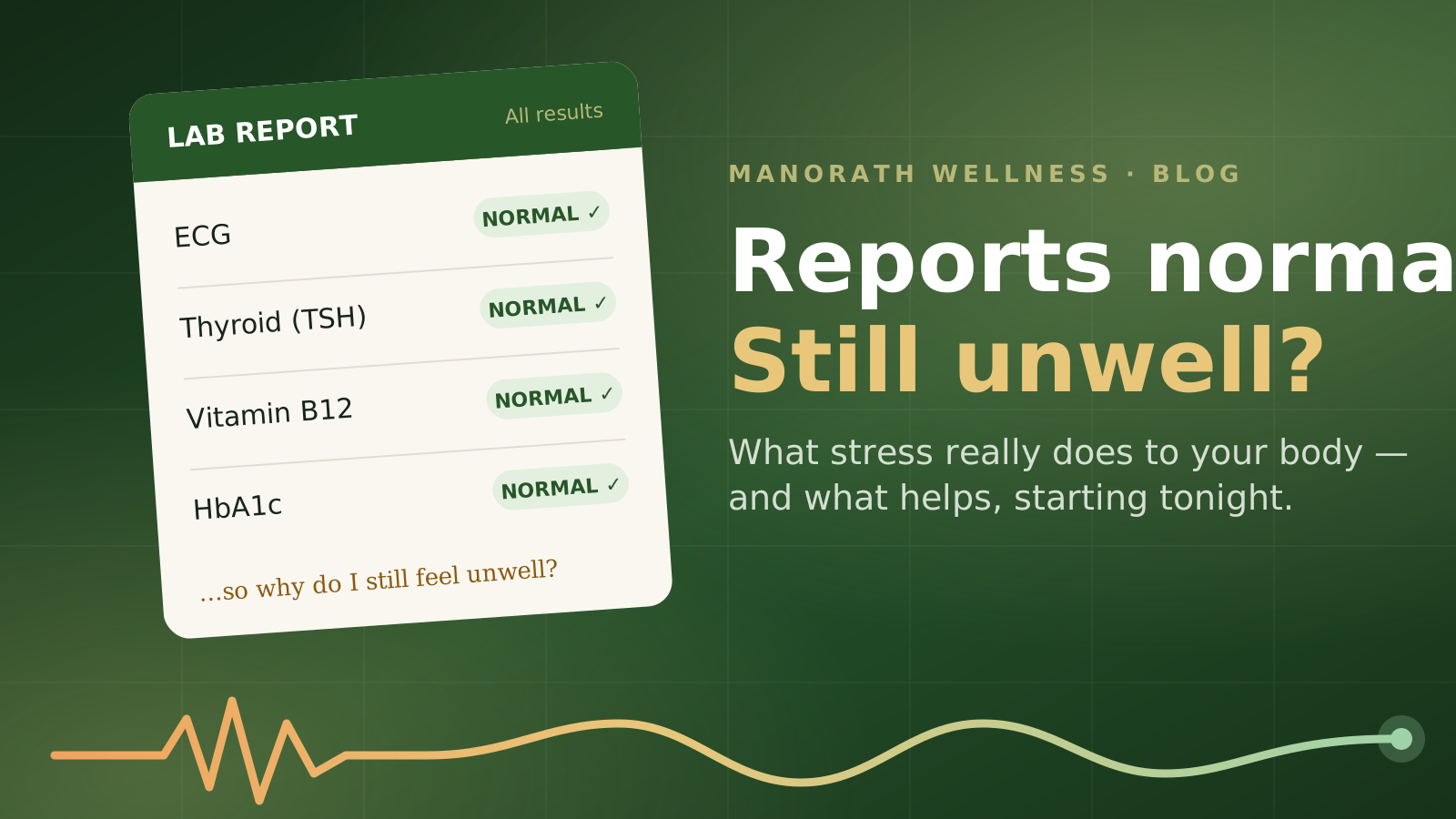
Many people arrive here having been to a hospital emergency department. ECG normal. Blood work normal. Sent home with "it was just anxiety" and no explanation. That is almost worse, because now you have no idea what it was or whether it will return.
So here is exactly what happened, step by step.
1. A surge of adrenaline. Your amygdala — the brain's threat detector — fired. It may have had no external reason at all. It can be triggered by a stray thought, a physical sensation, low blood sugar, caffeine, or nothing identifiable.
2. Your heart rate jumped. Adrenaline raises heart rate and blood pressure within seconds. You felt pounding or racing. This is the symptom most people interpret as cardiac.
3. Your breathing became fast and shallow. Automatic, not chosen. And this is where most of the frightening symptoms come from.
4. You exhaled too much carbon dioxide. Fast breathing — hyperventilation — drops blood CO₂. This raises blood pH, and that produces:
- Blood vessels narrowing, including to the brain → dizziness, light-headedness, blurred vision, a sense of unreality
- Nerves becoming more excitable → tingling in the hands, feet and around the mouth
- Chest wall muscles tightening → the chest pain, which is muscular, not cardiac
- Less oxygen released to tissues, despite plenty of oxygen in your blood — which is why breathing harder makes it worse rather than better
5. You concluded something was seriously wrong. Reasonably — these are alarming sensations. But that conclusion was itself a threat signal.
6. More adrenaline released. The loop closed. Each symptom confirmed the fear, and the fear produced more symptoms.
7. It peaked and began to pass — because adrenaline is metabolised and the body cannot sustain that state.
The central fact: every symptom you experienced was produced by adrenaline and over-breathing acting on a completely healthy body. That is why the tests found nothing. There was nothing to find.
Why it happens again — and this is the actual problem
The first attack is frightening. What turns it into panic disorder is what happens afterwards.
You start monitoring your body. Checking your pulse. Noticing every sensation in your chest.
This has an unfortunate consequence. Everyone's heart rate varies constantly — after stairs, after coffee, when startled, for no reason. You never noticed before. Now you notice every time, and each time you ask is it starting again?
That question is a threat signal. It releases a small amount of adrenaline. Which raises your heart rate slightly. Which you detect. Which confirms the fear.
This is called fear of fear, and it is what the condition actually becomes. You are no longer afraid of a situation — you are afraid of your own body.
Then avoidance begins. You stop driving alone. You avoid crowded markets, lifts, cinemas, long queues. You stay close to hospitals. Each avoidance brings short-term relief and teaches your brain: that place was genuinely dangerous and avoiding it saved me. So the list of unsafe places grows.
This is the part that shrinks a life, and it is also the part that responds best to treatment.
The part other centres leave out
What panic attack treatment in Jaipur can and cannot do
Panic disorder has one of the better outlooks in mental health. That is worth knowing at the start.
Weeks 1 to 2: attacks often become shorter and less intense once the breathing is practised daily. Frequency may not change yet.
Weeks 3 to 6: frequency drops. The fear between attacks reduces — which matters more than the attack count, because the anticipation is what dominates daily life.
Weeks 6 to 12: the avoidance comes back under your control. Driving, markets, lifts, travel. This is the part that returns your life.
What it asks of you: daily breathing practice, and willingness to do the exposure work. The exposure is uncomfortable by design and it is also the component that produces the durable change.
What we will not claim: you may have an occasional attack again under heavy stress. The goal is that it becomes a bad twenty minutes rather than a catastrophe — because you will know exactly what it is and exactly what to do.
When we refer you out: if attacks are daily, if there is significant depression alongside, if you cannot leave the house, or if you have any thoughts of self-harm, a psychiatrist should be involved and we will say so.
Always see a doctor first for chest pain. We are not equipped to assess cardiac risk.
If you are in crisis: Tele-MANAS 14416, free and 24 hours. In immediate danger, go to your nearest hospital.
Is it your heart? Rule this out properly
Get checked. Always. Especially a first episode. Chest pain must never be assumed to be panic without a medical assessment. Go to a doctor, get an ECG, and if advised, further cardiac tests.
Once you have been cleared, this comparison is useful:
| Panic attack | More concerning for cardiac |
|---|---|
| Comes on at rest, or sitting | Comes on during physical exertion |
| Peaks in about 10 minutes, then eases | Builds and persists, or worsens |
| Sharp or tight chest pain, often shifting | Heavy, crushing, pressing pain |
| Pain stays in the chest wall | Pain spreading to jaw, left arm, back |
| Tingling in hands and around the mouth | No tingling |
| Strong fear of dying is central | Fear present, but the pain dominates |
| Eases with slow breathing | Breathing makes no difference |
| ECG and troponin normal | ECG or blood markers abnormal |
If you have any doubt at all, treat it as cardiac and go to hospital. A wasted trip to an emergency department costs you an evening. The alternative is unacceptable. And once a cardiologist has cleared you, continuing to believe it was missed is itself part of the panic loop — which is something we work on directly.
Things that commonly trigger attacks
- Caffeine. Directly raises heart rate and adrenaline. A very common trigger, and often the easiest fix.
- Poor sleep. One bad night measurably lowers your threshold.
- Skipping meals. Low blood sugar produces shakiness and adrenaline surges that feel identical to the start of an attack.
- Alcohol, the day after. The rebound state lowers the threshold considerably.
- Heat and dehydration. Relevant in Jaipur's summer — both raise heart rate.
- Standing up quickly. A brief blood pressure drop can be misread as the onset.
- Crowded or hot enclosed places. Markets, lifts, buses, queues.
- Thinking about it. Genuinely. Anticipating an attack can produce one.
- Thyroid dysfunction, low B12, anaemia. Worth testing — all mimic this.
How we treat panic attacks in Jaipur
Breath retraining — the first and most important thing. You will learn slow breathing with an extended exhale until it is automatic. This is not relaxation; it is the direct correction for hyperventilation, and it is the only tool that works mid-attack. Most people can noticeably shorten an attack within two weeks of daily practice.
Understanding the mechanism. The explanation above, applied to your specific attack. This alone reduces attack frequency for many people, because the terror of not knowing what is happening is a large part of the fuel.
Interoceptive exposure — the technique that changes things most. Deliberately and safely producing the sensations you fear, in a controlled setting: spinning to create dizziness, breathing fast briefly to create tingling, running on the spot to raise your heart rate — and these are only done after we have checked that you have no heart condition, epilepsy, asthma, inner-ear or balance disorder, and are not pregnant, because voluntary over-breathing and spinning are unsafe in all of those. Where any apply, we use other exposure routes instead, and nothing is ever done without a doctor's clearance if your cardiac assessment is incomplete. Then sitting with it.
Why it works: your brain currently predicts racing heart = catastrophe. The only way to update that prediction is direct experience of the sensation without catastrophe following. Reassurance cannot do it. Experience can.
CBT. The catastrophic interpretations — this is a heart attack, I will faint, I will lose control, I will embarrass myself. Each one tested against what has actually happened across all your previous attacks.
Dropping safety behaviours. The pulse-checking, carrying water or medication "just in case", only going out with someone, sitting near exits. These feel protective and they maintain the condition, because they prevent your brain from learning that you were safe anyway.
Graded return to avoided places. Built as a hierarchy, at your pace, starting with the easiest. Nothing is ever forced.
Sleep correction and caffeine reduction, both of which lower the baseline.
Yoga therapy and meditation to lower resting arousal between attacks.
Your panic attack consultation in Jaipur — what happens
Registration — ₹500. Books a confirmed time slot.
First consultation. 45 minutes. ₹1,000 deposit in person, ₹500 online. We walk through one attack in detail — what you felt, in what order, what you thought, what you did. That sequence tells us what we are working with.
You leave with the breathing technique and the grounding method, practised in the room, not just described.
Following sessions. Typically around ₹2,000 each. Usually weekly at first.
Language. Hindi or English.
Registration and deposit are non-refundable.
Who you will work with
A female psychologist and counsellor is available for online consultation. Mention it when you book and your sessions are arranged with her.
Priyank Dadhich, founder — PGDYT (Post Graduate Diploma in Yoga Therapy), trained in naturopathy, clinical nutritionist. He has led the work at Manorath Wellness since the centre opened in 2022 — more than 4 years of solution-oriented practice in Jaipur.
Panic attack treatment in Jaipur — your questions answered
What should I do during a panic attack?
Breathe out longer than you breathe in — 4 counts in, 8 counts out. Sit upright, not flat. Name five things you can see. Do not fight it. It will peak within about ten minutes and pass. Fighting it adds fear, and fear adds adrenaline.
Why do I feel like I am dying during a panic attack?
Because the sense of impending death is a direct product of the adrenaline surge — it is a symptom, not an accurate assessment. Your brain is interpreting extreme physiological arousal as mortal danger. Knowing this does not stop it immediately, but it changes how you respond, and that changes the course of the attack.
Can panic attacks kill you or cause a heart attack?
No. A panic attack does not damage a healthy heart. The symptoms are produced by adrenaline and over-breathing. That said, chest pain should always be medically assessed, particularly a first episode — never assume.
My ECG and reports were normal. So what is wrong with me?
Nothing structural, which is why nothing was found. Your symptoms were real, produced by adrenaline acting on a healthy body. The tests were looking for disease; this is a nervous system response. Both facts are true at once.
Can panic attacks be cured without medicine?
Panic disorder responds very well to non-drug treatment — breath retraining, interoceptive exposure and CBT. International guidelines list CBT as a first-line treatment. Some people need medication alongside, which is a psychiatrist's decision.
Will I need medication for panic attacks?
Not necessarily, and we do not prescribe. If we think medication would help, we refer you to a psychiatrist. Many people recover substantially without it.
How long does panic attack treatment take?
Attacks often shorten within two weeks of daily breathing practice. Frequency drops over four to six weeks. Reclaiming avoided places takes eight to twelve weeks. These are typical ranges, not guarantees.
Why do I get panic attacks for no reason?
There usually is a reason, just not an obvious one — accumulated stress, sleep debt, caffeine, a physical sensation misread as threat, or in many cases a thought you did not consciously register. Part of the work is identifying your specific pattern.
I am scared to leave the house now. Is that part of this?
Yes, and it is the most common complication. Avoidance brings short-term relief and strengthens the fear long-term. It is addressed with graded exposure, at your pace, and nothing is forced.
Does caffeine cause panic attacks?
It does not cause the disorder, but it is one of the most common triggers — it directly raises heart rate and adrenaline, physically mimicking the onset. For many people reducing caffeine makes a noticeable difference within a week.
Is panic attack treatment in Jaipur available online as well?
Yes. Breath retraining and CBT both work well over video. Some exposure work is better in person, and we will discuss which applies to you.
How much do you charge for panic attack treatment in Jaipur?
₹500 registration, then ₹1,000 deposit in person or ₹500 online for the first consultation. Sessions after that are typically around ₹2,000 each. All non-refundable.
What tests should I get before starting panic attack treatment in Jaipur?
Thyroid profile, vitamin B12, vitamin D, haemoglobin and ferritin — all mimic panic symptoms. Plus an ECG through your doctor if you have had chest pain.
Visit our wellness centre in Jaipur
- Address
- Narayan Vihar, Mansarovar, Jaipur, Rajasthan
Open in Google Maps - Phone
- +91 78915 90022
- Message us on WhatsApp
- Hours
- Mon–Sat 9am–7pm at the centre
Online consultation all days - Parking
- Parking available at the centre
Manorath Wellness
Narayan Vihar, Mansarovar, Jaipur, Rajasthan
Easily reached from Mansarovar, Nirman Nagar, Sodala, Vaishali Nagar, Malviya Nagar and Ajmer Road. Online consultation available across India. Parking available.
What people tell us they want
“Not being afraid of my own body.”
How it starts
Three simple steps
- 1 Tell us what is going onA short form, a WhatsApp or a call — in Hindi or English.
- 2 A 45-minute consultationMind and body looked at together, at the centre or online.
- 3 A plan around your real dayFood, movement, sleep, breath and stress — and follow-ups that adjust.
Who you would be dealing with
- Led by
- Priyank Dadhich — PGDYT, clinical nutritionist
- Experience
- 4+ years · centre open since 2022
- Google rating
- 4.6 out of 5
- Our approach
- Healing without medicines — we treat the root cause
Rated 4.6/5 · since 2022 · medicine-free healing
Ready to start?
If you have had one attack, you are probably now afraid of the next one. That fear is the actual condition, and it is treatable.
₹500 registration gets you a confirmed slot. You will leave the first consultation knowing exactly what happens in your body during an attack, and with a breathing technique practised in the room.
Or call +91 78915 90022 · Mon–Sat 9am–7pm · Online all days